

ISTHIA
Institut Supérieur du Tourisme de l'hôtellerie et de l'Alimentation
by Juliane Boistel, on April 13, 2026
Food Studies, Gastronomy and Food Transformations:
An International Conference at the Crossroads of Cultures and Territories
From April 1 to 11, 2026, several students from the Master’s programme in Food Studies and Gastronomy based in Kuala Lumpur (Malaysia) took part in a study trip to France, at the heart of the Occitanie region. This educational journey, which is part of their curriculum, offers them the opportunity to discover French food culture directly in the field.
Accompanied this year by their programme director, Elise Mognard, the students followed a programme combining professional visits, tastings, workshops, and classes. From Ferme du Letou to the Le 500 training restaurant, via the Château de Cèdre vineyard and the Colomiers central kitchen, this trip enabled them to explore the diversity of French culinary expertise and the many cultural, social and territorial dimensions of food.
This immersion also gave rise to several opportunities for exchange with ISTHIA students and teaching teams, including a conference offered to students in the L3 Tourism, Hospitality and Food Studies programme. The presentation provided an original perspective on contemporary transformations in food practices in Southeast Asia, while illustrating the richness of the international partnerships developed by ISTHIA.
A Former ISTHIA Student Who Became an International Researcher
Elise Mognard’s career path reflects the international dimension of the academic trajectories developed within ISTHIA. A former student of the institute after completing a BTS in Hotel and Catering Management, she first continued her studies between Toulouse and Montreal before turning towards the social sciences applied to food.
After an initial professional experience in business development at an artisan cheesemonger, she embarked on a CIFRE doctoral thesis focusing on tourist experiences related to foie gras and the controversies surrounding force-feeding. Her research examined the links between food heritage, tourism, and contemporary food-related controversies.


It was through the long-standing partnership between Université Toulouse Jean Jaurès and Taylor’s University that she subsequently moved to Kuala Lumpur. Initially planned as a two-year postdoctoral experience, this academic mobility gradually evolved into a long-term commitment within Taylor’s University, where she now serves as Associate Professor.
She notably directs the Master’s programme in Food Studies and Gastronomy while leading the “Food Cultures & Health” research axis within the Centre for Asian Modernisation.
Understanding Food Transformations in Contemporary Asia
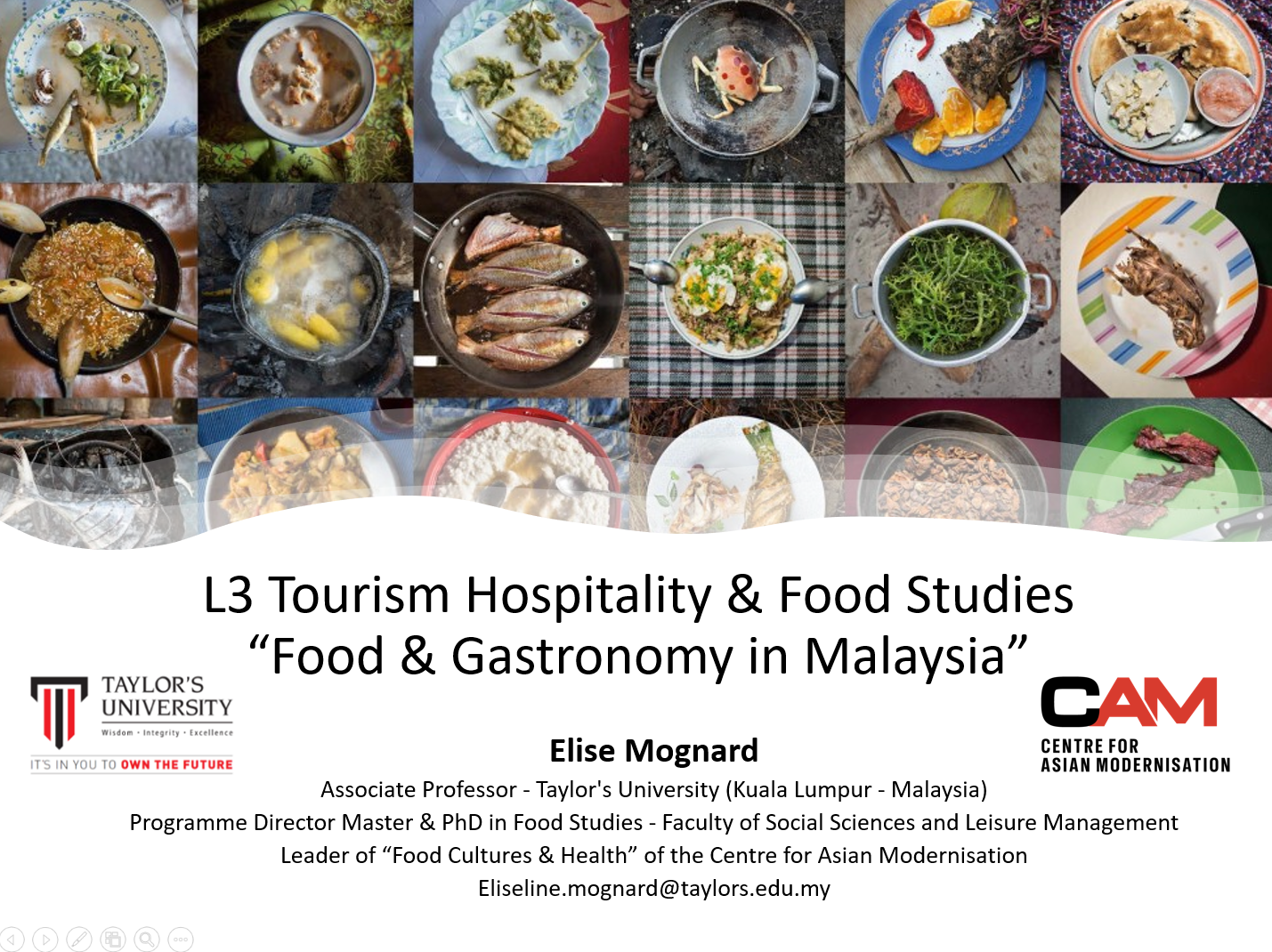
During her conference entitled Food & Gastronomy in Malaysia, Elise Mognard offered students an insight into the food and social transformations currently affecting contemporary Asian societies. The conference addressed the concepts of “compressed modernity” and cultural hybridisation through several case studies conducted in Malaysia and more broadly across Southeast Asia.
Through an approach rooted in the sociology of food and food studies, she presented research carried out over several years on food practices in Asia, notably within the framework of the Chair “Food Studies: Food, Cultures & Health” directed by Jean-Pierre Poulain, including the national survey Malaysian Food Barometer and the multi-site survey Eating Out in Asia (conducted in Malaysia, Indonesia, Japan, China, Hong Kong, Singapore and France).
These interdisciplinary studies combine sociology and anthropology in order to examine transformations in food systems through everyday practices and foster dialogue with nutrition and public health. Beyond questions such as: What do people eat? Where do they eat? When do they eat? Who prepares meals? How are family meals evolving? What place do meals eaten outside the home occupy?
These surveys analyse the combined effects of:
- urbanisation;
- changes in family structures;
- transformations in work patterns;
- and the rise of the middle classes;
- the globalisation of tastes.
The research presented notably highlights the growing importance of eating out, meaning meals consumed outside the home, in contemporary Asian societies, as well as the reconfiguration of boundaries between domestic and commercial spheres in food preparation.
Gastronomy, Heritage and Food Modernities
Elise Mognard notably drew on fieldwork conducted among the Kelabit, a minority ethnic group from Malaysian Borneo. This research explores the links between food heritage, tourism, hospitality and territorial dynamics in a context shaped by issues of cultural transmission and land protection.
Through the example of a local gastronomic festival and homestay accommodation initiatives developed in these rural territories, the conference highlighted the ways in which food heritage becomes simultaneously a cultural, tourism and identity resource.
At the same time, the presentation also offered a reflection on the urban and metropolitan food forms of contemporary Malaysia, characterised by the constant coexistence of traditional, colonial and globalised influences. A hybridisation that the researcher describes not as an exception, but as a daily norm of contemporary Asian societies.
A Structuring International Partnership for ISTHIA
Beyond the conference itself, this visit illustrates the vitality of the international partnerships developed by ISTHIA in the fields of tourism, hospitality and food studies.
The partnership with Taylor’s University now constitutes a privileged space for the circulation of students, academics and scientific projects between France and Southeast Asia. It also fosters the development of high-level interdisciplinary research at the intersection of social sciences, food cultures and contemporary issues related to food systems.
Through this conference, students of ISTHIA’s L3 THFS programme were able to discover international research rooted in contemporary social realities while engaging with a former graduate whose career path fully illustrates the academic and professional opportunities for openness offered by the institute.
Focus on the Bachelor’s Degree Year 3 Tourism, Hospitality and Food Studies (THFS)
Taught entirely in English on ISTHIA’s Toulouse campus, the third year of the Bachelor’s degree in Tourism, Hospitality and Food Studies (THFS) is primarily aimed at international students wishing to develop a cross-disciplinary approach to the tourism, hospitality and food studies sectors. The programme combines courses in management, geography, economics, sociology of food and territorial development, while offering a social and cultural understanding of contemporary food practices. Students acquire both operational and analytical skills applied to the tourism, hospitality and food industries within an international and intercultural perspective. This degree enables graduates either to enter professional careers in tourism, hospitality, catering or project development, or to pursue further studies at Master’s level, particularly within ISTHIA’s international and specialised programmes.
ISTHIA
Site de Toulouse
Campus du Mirail
5 Allées Antonio Machado, 31058 Toulouse Cedex 09
05 61 50 23 68
Site de Foix
Centre Universitaire de l'Ariège Robert Naudi
4 Rue Raoul Lafagette, 09000 Foix
Plan du site de Foix
05 61 02 19 74
Site de Cahors
Centre Universitaire Maurice Faure
273 Av. Henri Martin, 46000 Cahors
05 65 23 46 04